Shop 1, Chaitanya CHS , MHB Colony, Indira Nagar, Koliwada, Sion, Mumbai, Maharashtra 400022
contact us

How Businesses Can Protect Their Data

Cloud computing has become the backbone of modern business operations. From data storage and application hosting to remote collaboration and scalability, cloud platforms offer unmatched flexibility and efficiency. However, as cloud adoption accelerates, so do cloud-based security threats.
In 2025, attackers are increasingly targeting cloud environments due to misconfigurations, weak access controls, and lack of visibility. This blog explores the most common cloud security risks and outlines best practices businesses can follow to keep their data secure.
โš ๏ธ Common Cloud Security Risks
1. Cloud Misconfigurations
Misconfigured cloud storage, databases, and access permissions remain one of the leading causes of data breaches.
Examples include:
  • Publicly exposed storage buckets
  • Over-privileged user roles
  • Insecure APIs
Impact:
Unauthorized access, data leaks, and compliance violations.
2. Weak Identity and Access Management (IAM)
Poorly managed credentials allow attackers to gain access using stolen or compromised login details.
Risk Factors:
  • Shared accounts
  • Lack of multi-factor authentication
  • Excessive access privileges
๐Ÿ›ก๏ธ Why Cloud Security Is a Business Priority
Cloud security is not just an IT issueโ€”itโ€™s a business requirement. A single breach can disrupt operations, damage brand reputation, and result in significant financial loss.
Strong cloud security helps organizations:
  • Maintain data confidentiality
  • Meet regulatory requirements
  • Ensure business continuity

Customizable Solutions

Tailored Cybersecurity Built Around Your Business


๐Ÿ›ก๏ธ Hero Section

One Size Doesnโ€™t Fit All โ€” Your Security Shouldnโ€™t Either

Every organization has unique risks, infrastructure, compliance requirements, and business goals.
Sanji Customizable Security Solutions are designed specifically around your environment โ€” not generic templates.

๐Ÿ”ต Request Custom Solution
โšช Schedule Strategy Session


๐ŸŽฏ Why Custom Security Matters

Pre-packaged cybersecurity services often:

  • Miss business-specific risks
  • Overlook regulatory nuances
  • Create tool overload
  • Increase unnecessary costs
  • Fail to integrate with existing infrastructure

Sanji designs solutions aligned with your:

โœ” Industry
โœ” Risk profile
โœ” Budget
โœ” Compliance requirements
โœ” Business growth strategy


๐Ÿ” What We Customize

1๏ธโƒฃ Security Architecture Design

  • Network segmentation strategy
  • Zero-trust architecture planning
  • Cloud security design
  • Hybrid infrastructure protection

2๏ธโƒฃ Monitoring & Detection Setup

  • Custom SIEM configuration
  • Tailored alert thresholds
  • Business-based risk scoring
  • Industry-specific threat intelligence

3๏ธโƒฃ Compliance-Aligned Frameworks

  • RBI-aligned controls (for BFSI)
  • CERT-In reporting alignment
  • ISO 27001 readiness support
  • NIST-based maturity enhancement

4๏ธโƒฃ Incident Response Playbooks

  • Customized IR workflows
  • Escalation matrix design
  • Crisis communication strategy
  • Role-based response planning

5๏ธโƒฃ Security Policy Development

  • Information security policies
  • Access control frameworks
  • Vendor risk policies
  • Data protection governance

๐Ÿง  Our Customization Process

Step 1 โ€“ Business & Risk Understanding

  • Industry evaluation
  • Asset criticality review
  • Risk appetite definition

Step 2 โ€“ Gap & Maturity Assessment

  • Security posture evaluation
  • Control gap analysis
  • Compliance mapping

Step 3 โ€“ Tailored Security Blueprint

  • Architecture design
  • Tool recommendations
  • Control prioritization
  • Budget optimization

Step 4 โ€“ Implementation & Integration

  • Deployment support
  • Configuration guidance
  • Team coordination
  • Documentation delivery

Step 5 โ€“ Continuous Optimization

  • Periodic review
  • Risk re-evaluation
  • Control effectiveness analysis

๐Ÿข Who Benefits from Custom Solutions?

  • Growing startups scaling securely
  • Banks & NBFCs with RBI oversight
  • FinTech firms with rapid innovation
  • Enterprises migrating to cloud
  • Organizations building SOC from scratch
  • Companies undergoing digital transformation

๐Ÿ“Š Business Benefits

โœ… Security aligned to actual risk
โœ… Cost-optimized control deployment
โœ… Reduced tool redundancy
โœ… Improved compliance readiness
โœ… Stronger executive-level visibility
โœ… Scalable security architecture


๐Ÿฆ India-Focused Regulatory Alignment

Our customizable solutions support alignment with:

  • RBI Cyber Security Framework
  • CERT-In Directives
  • ISO/IEC 27001
  • NIST Cybersecurity Framework
  • Data Protection & Privacy requirements

๐Ÿ”„ Engagement Models

โœ” Project-Based Custom Deployment

Defined scope with structured deliverables.

โœ” Long-Term Strategic Security Partnership

Continuous advisory & implementation support.

โœ” Virtual CISO (vCISO) Model

Ongoing cybersecurity leadership without full-time CISO cost.


๐Ÿ’ฌ Why Choose Sanji Solutions LLP?

  • Business-first cybersecurity approach
  • Deep understanding of Indian regulatory landscape
  • Practical & scalable security designs
  • Transparent reporting
  • Experienced cybersecurity consultants
  • Focus on long-term resilience

๐Ÿ“ž Call to Action Section

Build Security That Fits Your Business : Not the Other Way Around

Letโ€™s design a cybersecurity strategy tailored specifically for your organization.

๐Ÿ”ต Request Customized Security Plan
โšช Speak to Security Consultant


Sanji Customizable Security Solutions deliver tailored cybersecurity architecture, compliance alignment, and risk-based protection for enterprises across India.

Comprehensive Risk Assessment

Identify Risks. Strengthen Controls. Protect Your Business.

You can directly paste this into Elementor (Free version) and structure it as separate sections.


๐Ÿ›ก๏ธ Hero Section

Understand Your Cyber Risks Before Attackers Do

Every organization has hidden security gaps.
Sanji Comprehensive Risk Assessment identifies vulnerabilities, evaluates threats, and provides a prioritized roadmap to reduce cyber risk and strengthen compliance posture.

๐Ÿ”ต Request Risk Assessment
โšช Schedule Consultation


๐Ÿ“Œ Why Risk Assessment Is Critical

Cyber risks evolve constantly โ€” from ransomware and insider threats to cloud misconfigurations and third-party exposure.

Without structured risk assessment:

  • Security gaps remain unnoticed
  • Compliance violations increase
  • Critical assets lack protection
  • Incident response becomes reactive
  • Business continuity is at risk

Sanji provides a business-aligned, regulator-ready cyber risk evaluation framework.


๐Ÿ” What Our Comprehensive Risk Assessment Covers

1๏ธโƒฃ Asset Identification & Classification

  • Critical systems mapping
  • Data sensitivity classification
  • Business impact analysis
  • Crown-jewel identification

2๏ธโƒฃ Threat & Vulnerability Assessment

  • Threat landscape evaluation
  • Internal & external vulnerability review
  • Attack surface analysis
  • Third-party risk exposure

3๏ธโƒฃ Security Control Review

  • Network security controls
  • Endpoint security posture
  • Identity & access management review
  • Cloud security configuration assessment

4๏ธโƒฃ Governance & Compliance Review

  • Policy and procedure evaluation
  • Regulatory alignment analysis
  • Security awareness maturity
  • Incident readiness assessment

๐Ÿ“Š Risk Assessment Methodology

Phase 1 โ€“ Scoping & Planning

  • Define business objectives
  • Identify critical assets
  • Determine assessment boundaries

Phase 2 โ€“ Risk Identification

  • Identify threats
  • Evaluate vulnerabilities
  • Analyze likelihood and impact

Phase 3 โ€“ Risk Analysis

  • Risk scoring (Low / Medium / High / Critical)
  • Quantitative & qualitative assessment
  • Prioritization of findings

Phase 4 โ€“ Risk Treatment Planning

  • Mitigation recommendations
  • Control enhancement roadmap
  • Investment prioritization guidance

Phase 5 โ€“ Executive Reporting

  • Risk dashboard
  • Executive summary
  • Technical findings report
  • Compliance mapping

๐Ÿง  Key Risk Areas We Evaluate

  • Network security architecture
  • Endpoint protection maturity
  • Privileged access risks
  • Cloud misconfigurations
  • Application security weaknesses
  • Third-party & vendor risks
  • Backup & disaster recovery readiness
  • Security monitoring effectiveness

๐Ÿฆ Regulatory & Framework Alignment

Our assessment aligns with:

  • RBI Cyber Security Framework
  • CERT-In Guidelines
  • ISO/IEC 27001 Risk Management Controls
  • NIST Cybersecurity Framework
  • COBIT governance principles

๐Ÿ“ˆ Business Benefits

โœ… Clear visibility of cyber risk exposure
โœ… Prioritized remediation roadmap
โœ… Improved compliance readiness
โœ… Reduced likelihood of breach
โœ… Better budget allocation decisions
โœ… Stronger board-level reporting


๐Ÿข Who Should Opt for This Service?

  • Banks & NBFCs
  • FinTech companies
  • IT & SaaS firms
  • Healthcare organizations
  • Manufacturing enterprises
  • Government & PSU entities

If your organization relies on digital systems โ€” structured risk assessment is essential.


๐Ÿ› ๏ธ Service Delivery Models

โœ” One-Time Risk Assessment

Full environment review with detailed report.

โœ” Annual Risk Review

Periodic risk reassessment for compliance.

โœ” Risk + Monitoring Integration

Risk Assessment combined with Advanced Threat Monitoring.


๐Ÿ’ฌ Why Choose Sanji Solutions LLP?

  • India regulatory-aligned framework
  • Experienced cybersecurity consultants
  • Business-driven risk analysis
  • Clear executive-level reporting
  • Practical remediation recommendations
  • Customized assessment approach

๐Ÿ“ž Call to Action Section

Donโ€™t Wait for a Breach to Discover Your Risks

Proactively identify, analyze, and mitigate your cyber risks today.

๐Ÿ”ต Request Comprehensive Risk Assessment
โšช Talk to Risk Expert


Sanji Comprehensive Risk Assessment identifies cyber vulnerabilities, evaluates security controls, and provides aligned risk mitigation strategies for enterprises in India.


Expert Incident Response

๐Ÿšจ Expert Incident Response

Rapid Containment. Precise Investigation. Stronger Recovery.


๐Ÿ”ฅ Hero Section

When Every Minute Matters, We Respond.

Cyber incidents can disrupt operations, damage reputation, and trigger regulatory penalties.
Sanji Expert Incident Response delivers rapid containment, deep forensic investigation, and structured recovery to minimize business impact.

๐Ÿ”ต Request Emergency Support
โšช Schedule IR Consultation


๐Ÿšจ Why Incident Response Is Critical

A cyber incident is not a matter of if โ€” itโ€™s a matter of when.

Without expert response:

  • Breaches expand silently
  • Data exfiltration continues
  • Regulatory exposure increases
  • Business downtime escalates
  • Reputation damage becomes permanent

Sanji ensures structured, professional, and regulator-aligned incident handling.


๐Ÿ› ๏ธ Our Incident Response Capabilities

1๏ธโƒฃ Rapid Incident Containment

  • Immediate threat isolation
  • Network segmentation guidance
  • Account lockdown procedures
  • Malware containment

2๏ธโƒฃ Digital Forensic Investigation

  • Log and endpoint analysis
  • Timeline reconstruction
  • Root cause identification
  • Evidence preservation

3๏ธโƒฃ Malware & Ransomware Analysis

  • Malware behavior analysis
  • Ransomware infection tracing
  • Decryption feasibility assessment
  • Persistence mechanism detection

4๏ธโƒฃ Regulatory & Compliance Support

  • CERT-In reporting guidance
  • Aligned incident handling
  • Documentation for auditors
  • Legal coordination support

5๏ธโƒฃ Business Recovery & Hardening

  • System restoration strategy
  • Vulnerability remediation
  • Security architecture improvements
  • Post-incident review

๐Ÿ” Types of Incidents We Handle

  • Ransomware attacks
  • Data breaches
  • Insider threats
  • Business Email Compromise (BEC)
  • DDoS attacks
  • Web application compromise
  • Cloud security incidents
  • APT (Advanced Persistent Threat) intrusions

๐Ÿง  Our Structured Response Methodology

Phase 1 โ€“ Identification

  • Incident validation
  • Impact assessment
  • Threat classification

Phase 2 โ€“ Containment

  • Immediate threat isolation
  • Access revocation
  • Lateral movement prevention

Phase 3 โ€“ Eradication

  • Malware removal
  • Backdoor elimination
  • Configuration correction

Phase 4 โ€“ Recovery

  • System restoration
  • Monitoring enhancement
  • Business continuity validation

Phase 5 โ€“ Post-Incident Review

  • Root cause report
  • Lessons learned
  • Security improvement roadmap

๐Ÿ“Š Business Benefits

โœ… Reduced downtime
โœ… Minimized financial loss
โœ… Preserved digital evidence
โœ… Faster regulatory compliance
โœ… Controlled reputational damage
โœ… Stronger post-incident security posture

Advanced Threat Monitoring

Sanji Advanced Threat Monitoring (ATM) is a 24x7 proactive cybersecurity monitoring and threat detection service designed to identify, analyze, and respond to sophisticated cyber threats before they impact your business.

We combine intelligent monitoring, real-time alerting, threat intelligence, and expert analysis to protect your digital assets.


๐ŸŽฏ Key Objectives

  • Detect advanced persistent threats (APTs)
  • Identify insider threats
  • Monitor unusual behavior across endpoints & networks
  • Reduce Mean Time to Detect (MTTD)
  • Reduce Mean Time to Respond (MTTR)
  • Ensure regulatory compliance (RBI, SEBI, ISO 27001 aligned)

โš™๏ธ Core Components

1๏ธโƒฃ 24x7 Security Monitoring

  • Real-time log analysis
  • Continuous network traffic monitoring
  • Endpoint activity tracking
  • Cloud security monitoring

2๏ธโƒฃ Threat Intelligence Integration

  • Global threat feeds
  • Dark web monitoring
  • IOC (Indicators of Compromise) correlation
  • Zero-day threat awareness

3๏ธโƒฃ Behavioral Analytics

  • User & Entity Behavior Analytics (UEBA)
  • Anomaly detection
  • Privilege misuse detection

4๏ธโƒฃ Incident Detection & Alerting

  • Risk-based alert prioritization
  • Automated alert validation
  • Escalation matrix

5๏ธโƒฃ Rapid Incident Response Support

  • Containment guidance
  • Forensic data preservation
  • Root cause analysis
  • Remediation recommendations

๐Ÿ› ๏ธ Technologies We Use

  • SIEM (Security Information & Event Management)
  • EDR/XDR platforms
  • SOAR automation
  • Threat Intelligence Platforms
  • Network Detection & Response (NDR)

๐Ÿ“Š What We Monitor

LayerMonitoring Focus
NetworkSuspicious traffic, lateral movement
EndpointsMalware, ransomware, abnormal processes
IdentityPrivilege escalation, brute force
CloudMisconfigurations, suspicious API calls
ApplicationsWeb attacks, SQL injection, XSS

๐Ÿ“ˆ Benefits to Clients

โœ… Early threat detection
โœ… Reduced breach impact
โœ… Improved compliance posture
โœ… 24x7 SOC expertise
โœ… Business continuity protection

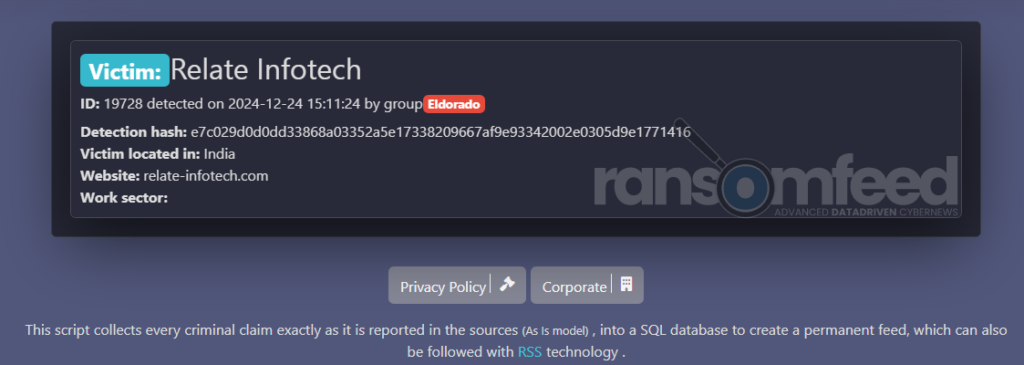
#Attack Pattern โ€“ Eldorado

Date and Time: 2024-12-24 15:11:24

Threat Actor:  Eldorado

WebSite/Company: Relate Infotech, India  URLInof:  URLInof:  http://www.ransomfeed.it/index.php?page=post_details&id_post=19728

The Eldorado attack pattern refers to a targeted and sophisticated attack methodology often associated with advanced persistent threats (APTs). This type of attack typically involves carefully crafted techniques designed to exploit specific systems, bypass defenses, and maintain long-term access for espionage or data theft purposes.

  1. Reconnaissance:
  1. Attackers extensively research their targets, focusing on high-value individuals, sensitive systems, or organizational vulnerabilities.
  2. Open-source intelligence (OSINT), social engineering, and spear-phishing campaigns are common during this phase.
  3. Initial Compromise:
  1. Exploitation of zero-day vulnerabilities or well-known vulnerabilities in unpatched systems.
  2. Use of malicious email attachments, links, or watering hole attacks to infiltrate the target environment.
  3. Privilege Escalation:
  1. Once inside the system, attackers escalate privileges using tools like Mimikatz or by exploiting weak credential management.
  2. Lateral movement is planned to gain access to critical resources.
  3. Persistence:
  1. Attackers establish a foothold in the network through backdoors, malicious implants, or rootkits.
  2. This ensures long-term access even after remediation attempts.
  3. Exfiltration:
  1. Data is exfiltrated using stealthy methods such as encryption, steganography, or slow trickle techniques to avoid detection.
  2. Often, the focus is on intellectual property, financial data, or sensitive communications.
  3. Evading Detection:
  1. Advanced tactics include disabling logging, leveraging fileless malware, and using compromised trusted accounts.
  2. Constant adaptation to changes in security measures implemented by the victim.

Indicators of Compromise (IoCs):

  • Unusual Network Traffic: Sudden spikes or abnormal traffic patterns to suspicious external IP addresses.
  • Unauthorized Access Attempts: Repeated login failures followed by successful logins from unknown or geographically inconsistent IPs.
  • New or Unexpected Processes: Unknown processes running on critical servers.
  • File System Modifications: Creation or alteration of files in sensitive directories without administrative activity.

Mitigation Strategies:

  1. Proactive Monitoring:
  1. Implement a Security Information and Event Management (SIEM) system with real-time monitoring for anomalies.
  2. Regularly review threat intelligence feeds to update defense mechanisms.
  3. Incident Response Plan:
  1. Ensure a well-documented and tested incident response plan is in place.
  2. Conduct tabletop exercises to prepare for such sophisticated attacks.
  3. Vulnerability Management:
  1. Regularly patch systems to mitigate exploitation risks.
  2. Use vulnerability scanners to identify and remediate weaknesses.
  3. Network Segmentation:
  1. Limit access to sensitive systems through segmentation and least privilege principles.
  2. Use firewalls and microsegmentation to control lateral movement.
  3. Advanced Threat Detection:
  1. Deploy Endpoint Detection and Response (EDR) tools.
  2. Use behavioral analytics to identify deviations from normal user activity.

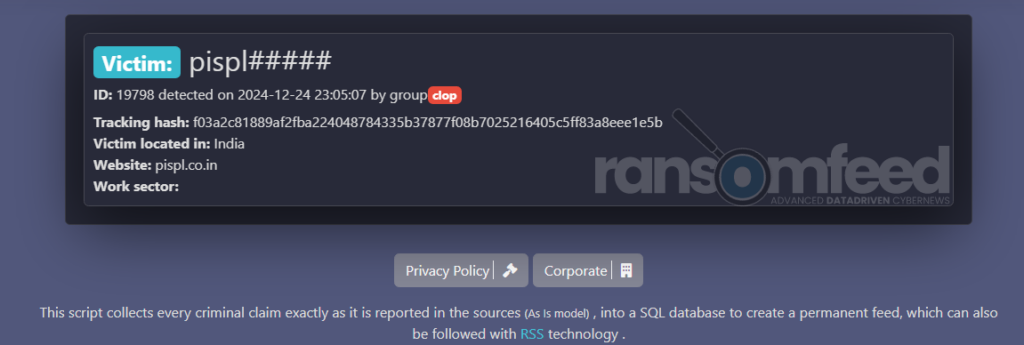
#Ransomware Attack in India

  1. Date and Time: 2024-12-24 23:05:07
    Threat Actor:  clop
    WebSite:  pisp.co.in, India
    URLInof: http://www.ransomfeed.it/index.php?page=post_details&id_post=19798

Attack Pattern โ€“ clop

1. Initial Access

  • Tactics Used: Phishing, Exploit Public-Facing Applications
  • Hunting Tips:
    • Look for spear-phishing emails with malicious attachments or links (e.g., ZIP files with malicious JavaScript or Excel macros).
    • Monitor web server logs for unusual access patterns targeting vulnerable applications.
    • Detect abuse of remote access protocols like RDP or VPN credentials.

2. Execution

  • Tactics Used: Script Execution, Payload Droppers
  • Hunting Tips:
    • Identify PowerShell or Windows Command Prompt activities initiating network connections.
    • Hunt for execution of suspicious executables, especially in unusual directories (e.g., C:\Users\Public or temp folders).
    • Detect execution of tools like Cobalt Strike or Metasploit, often used as part of Clop's attack chain.

3. Privilege Escalation

  • Tactics Used: Credential Dumping, Exploitation for Privilege Escalation
  • Hunting Tips:
    • Monitor for SAM database access (e.g., reg save HKLM\SAM commands).
    • Look for suspicious parent-child process relationships (e.g., LSASS being accessed by non-standard processes).
    • Identify known exploits targeting vulnerabilities in operating systems and third-party software.

4. Persistence

  • Tactics Used: Scheduled Tasks, Registry Run Keys, DLL Injection
  • Hunting Tips:
    • Look for unusual modifications to registry keys (e.g., HKCU\Software\Microsoft\Windows\CurrentVersion\Run).
    • Analyze scheduled tasks and startup programs for suspicious entries.
    • Detect persistence via hijacked legitimate DLLs.

5. Lateral Movement

  • Tactics Used: SMB, RDP, PsExec
  • Hunting Tips:
    • Monitor for excessive SMB traffic or unusual use of administrative shares.
    • Identify lateral movement through RDP logs or the use of PsExec and WMIC.
    • Look for suspicious files and scripts copied to shared drives.

6. Data Exfiltration

  • Tactics Used: File Transfer Tools, Network Tunneling
  • Hunting Tips:
    • Detect large outbound data transfers, especially encrypted traffic to unknown IPs.
    • Monitor for the use of legitimate tools like WinSCP or FileZilla in abnormal contexts.
    • Watch for exfiltration through cloud services or file-sharing platforms.

7. Ransomware Deployment

  • Tactics Used: Encrypted Payload, Command and Control (C2)
  • Hunting Tips:
    • Hunt for encryption toolkits executed in the network, often targeting file extensions en masse.
    • Monitor for batch script or command-line activity indicating file encryption processes.
    • Detect communication with Clopโ€™s known C2 infrastructure or IP addresses.

8. Indicators of Compromise (IOCs)

  • File Names/Hashes:
    • Known Clop ransomware executable hashes (search for updated IOC databases).
    • Suspiciously renamed executables mimicking legitimate processes.
  • Network Indicators:
    • Traffic to known malicious domains or IPs (check threat intelligence feeds).
    • Use of ports like 443 or non-standard ones for C2 communication.

9. Tools and Techniques

  • Clop-Specific Patterns:
    • Evidence of exploitation of Accellion File Transfer Appliance vulnerabilities (used by Clop previously).
    • Detection of Clopโ€™s dropper binaries or associated malware like FlawedAmmyy RAT.

Automation and Queries

  • SIEM Queries:
  • Hunt for suspicious process execution:
sql
Copy code
index=main sourcetype=wineventlog
|search (EventCode=4688) AND (CommandLine="*PowerShell*" OR CommandLine="*.exe")
  • Search for abnormal user behaviors indicating credential compromise:
sql
Copy code
index=main sourcetype=authentication
| stats count by UserName, EventType
|where count > threshold
  • EDR/IDS Rules:
  • Detect behavioral patterns like mass file changes or rapid process spawning.

Indicators of Compromise (IoCs):

1. File Hashes:

  • Executable Samples:
    • SHA256: e7b6c5d8e8f2a3b4c5d6e7f8a9b0c1d2e3f4a5b6c7d8e9f0a1b2c3d4e5f6a7b8
    • SHA256: d4c3b2a1f0e9d8c7b6a5e4d3c2b1a0f9e8d7c6b5a4e3d2c1b0a9f8e7d6c5b4a3

2. Network Indicators:

  • Domains:
    • clop.example.com
    • secure.example.net
  • IP Addresses:
    • 192.168.1.100
    • 10.0.0.50

3. Email Indicators:

  • Subject Lines:
    • "Invoice Attached"
    • "Payment Confirmation"
  • Sender Addresses:
    • billing@example.com
    • accounts@example.org

4. Registry Changes:

  • Persistence Mechanisms:
    • Creates registry key: HKCU\Software\Microsoft\Windows\CurrentVersion\Run\Clop
    • Modifies registry key: HKLM\SYSTEM\CurrentControlSet\Services\SharedAccess\Parameters\FirewallPolicy\StandardProfile\AuthorizedApplications\List to include the ransomware executable

5. File System Changes:

  • Encrypted File Extensions:
    • .clop
    • .ciop
  • Dropped Files:
    • ClopReadMe.txt
    • DecryptInstructions.html

6. Processes and Services:

  • Suspicious Processes:
    • clop.exe
    • ciop_service.exe
  • Service Creation:
    • Creates and starts a service named "ClopService"

7. Exploited Vulnerabilities:

  • CVE-2023-34362: MOVEit Transfer SQL injection vulnerability exploited by Clop ransomware gang.

8. Command and Control (C2) Communication:

  • Protocols:
    • Uses HTTPS for encrypted communication
  • Behavior:
    • Periodic beaconing to C2 servers
    • Data exfiltration over HTTP/HTTPS

9. Additional Indicators:

  • Mutexes Created:
    • Global\ClopMutex
  • Scheduled Tasks:
    • Creates a task named "ClopUpdate" to ensure persistence

#Enhancing Your Cybersecurity Posture: Strategies for Modern Organizations

Understanding the Importance of Cybersecurity

In today's digital landscape, organizations face an ever-evolving array of cyber threats. From sophisticated malware to ransomware attacks, protecting your digital assets is more crucial than ever. This blog post outlines effective strategies to enhance your cybersecurity posture and mitigate risks.

Reduce Your Attack Surface

Your attack surface is the total number of points (attack vectors) in your environment that could potentially be exploited by a malicious actor. Reducing this surface is vital for minimizing vulnerabilities.

  • Regular Updates: Ensure that all software, applications, and operating systems are updated regularly to patch known vulnerabilities.
  • Restrict User Access: Limit access rights based on user roles to minimize unauthorized access to sensitive data and systems.
  • Network Segmentation: Divide your network into segments to contain breaches and limit lateral movement of attackers.

Detecting Advanced Threats

Implementing robust detection capabilities is essential for identifying and mitigating advanced threats before they cause significant damage.

  • SIEM Solutions: Utilize Security Information and Event Management (SIEM) tools to collect and analyze security data in real-time.
  • Threat Hunting: Actively seek out threats in your network using threat hunting techniques to find hidden anomalies and suspicious activities.
  • Behavioral Analysis: Monitor user and entity behavior to detect deviations from normal patterns that may indicate a threat.

Incident Response Planning

An efficient incident response plan is crucial for quickly and effectively managing a cyber incident when it occurs.

  • Developing SOAR Playbooks: Create automated Security Orchestration, Automation and Response (SOAR) playbooks that outline specific protocols for different types of incidents.
  • Tabletop Exercises: Conduct regular tabletop exercises that simulate incidents to test your response protocols and improve team readiness.
  • Post-Incident Review: After an incident, perform a review to identify what went well, what didnโ€™t, and how to improve future responses.

Leveraging Digital Forensics

Digital forensics plays a critical role in understanding the cause of a security breach and in preserving evidence for legal actions.

  • Data Preservation: Ensure that all data related to an incident is preserved securely for analysis and legal purposes.
  • Root Cause Analysis: Conduct a thorough investigation to understand how the breach occurred and to identify weaknesses in your systems.
  • Report Findings: Document findings in a clear and detailed report to share with stakeholders and use for improving security measures.

Conclusion

Enhancing your organization's cybersecurity posture requires a proactive approach that focuses on reducing your attack surface, detecting advanced threats, and having a robust incident response plan. By implementing these strategies, including leveraging SIEM solutions, developing SOAR playbooks, and utilizing digital forensics, your organization can significantly improve its readiness against cyber threats. Prioritize cybersecurity today to safeguard your business for tomorrow.

#Mastering Cybersecurity: Essential Strategies for Strengthening Your Organization’s Defenses

Mastering Cybersecurity: Essential Strategies for Strengthening Your Organizationโ€™s Defenses


Understanding Your Attack Surface

The first step in reducing your organization's risk is understanding your attack surface. This includes all the points where an unauthorized user could breach your systems.

  • Network Security: Ensure firewalls, intrusion detection systems (IDS), and proper network segmentation are in place.
  • Application Security: Regularly use Vulnerability Assessment and Penetration Testing (VAPT) to identify and mitigate weaknesses in your applications.
  • User Awareness: Train employees on security best practices to decrease the likelihood of human error.

Detecting Advanced Threats

Advanced threats often go unnoticed until itโ€™s too late. To proactively detect them, consider these strategies:

  • Threat Intelligence: Implement threat intelligence services to gather information on emerging threats.
  • SIEM Use-Cases: Develop specific use-cases tailored to your organization's needs, enabling quick identification of suspicious activities.
  • Continuous Monitoring: Utilize Security Information and Event Management (SIEM) tools to continuously monitor traffic and user behavior for abnormal patterns.

Effective Incident Response

Preparation is key when it comes to incident response. Building robust incident response plans includes:

  • SOAR Playbooks: Create and automate Security Orchestration, Automation, and Response (SOAR) playbooks that guide your team during an incident.
  • Cross-Team Tabletop Exercises: Conduct regular tabletop exercises involving all relevant teams to ensure readiness and collaboration in the event of an incident.

Importance of Digital Forensics

Digital forensics plays a crucial role in the post-incident phase. Hereโ€™s how you can leverage it:

  • Data Preservation: Ensure proper data collection and preservation procedures are followed for potential legal proceedings.
  • Root Cause Analysis: Use forensic analysis to determine how a breach occurred and prevent similar incidents in the future.

Staying Ahead in Cybersecurity

To maintain a strong cybersecurity posture, regularly review and update your security strategies. Here are a few final tips:

  • Regular Training: Keep your employees updated on the latest security threats and techniques to mitigate risks.
  • Invest in Technology: Utilize the latest cybersecurity tools and software tailored to your organizationโ€™s needs.
  • Threat Hunting: Proactively look for hidden threats in your environment rather than waiting for them to be detected.

Conclusion

By understanding and implementing these strategies, organizations can significantly enhance their security defenses. The key lies in continuous improvement, proactive detection, and a solid incident response plan, all of which are vital in todayโ€™s ever-evolving cybersecurity landscape.

#SANJI Team

Effective cybersecurity leadership requires a strategic vision from company owners and top management that moves security from a back-office IT issue to a core business enabler, according to recent insights. Modern cyber leadership emphasizes proactive risk management, fostering a "security-first" culture, and aligning security initiatives directly with company goals to build digital trust.ย 

Core Components of a Security-Driven Vision

Strategic Alignment:ย Security should enable business growth and innovation, rather than act as a barrier. This means integrating security into M&A, product development, and digital transformation initiatives.

Top-Down Responsibility:ย Company owners must treat cyber risk as a fundamental business risk, not just an IT concern. This involves understanding critical digital assets and the financial/reputational impact of breaches.

From "Secure by Default" to Resilience:ย Forward-thinking leaders focus on creating a resilient organization that can quickly detect, respond, and recover from incidents, accepting that breaches are a matter of "when," not "if".

Simplification and Automation:ย Effective leaders (referred to as "Secure Creators") reduce complexity by consolidating security tools and utilizing automation (AI/ML) to speed up detection and response.