

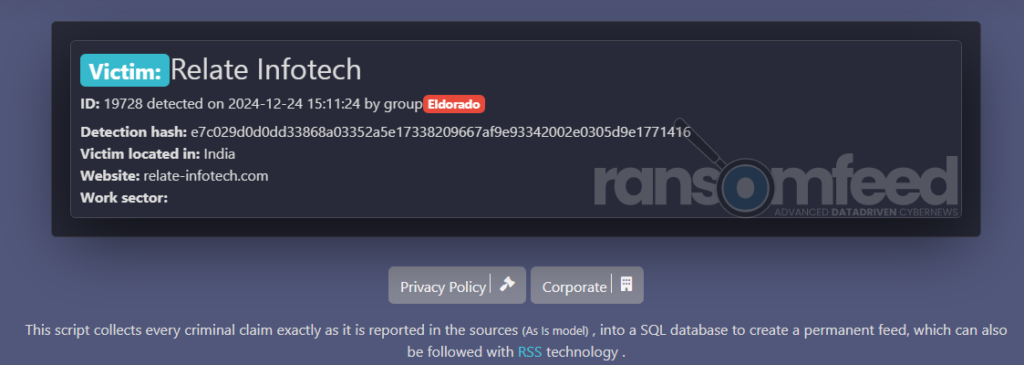
Date and Time: 2024-12-24 15:11:24
Threat Actor: Eldorado
WebSite/Company: Relate Infotech, India URLInof: URLInof: http://www.ransomfeed.it/index.php?page=post_details&id_post=19728
The Eldorado attack pattern refers to a targeted and sophisticated attack methodology often associated with advanced persistent threats (APTs). This type of attack typically involves carefully crafted techniques designed to exploit specific systems, bypass defenses, and maintain long-term access for espionage or data theft purposes.
- Reconnaissance:
- Attackers extensively research their targets, focusing on high-value individuals, sensitive systems, or organizational vulnerabilities.
- Open-source intelligence (OSINT), social engineering, and spear-phishing campaigns are common during this phase.
- Initial Compromise:
- Exploitation of zero-day vulnerabilities or well-known vulnerabilities in unpatched systems.
- Use of malicious email attachments, links, or watering hole attacks to infiltrate the target environment.
- Privilege Escalation:
- Once inside the system, attackers escalate privileges using tools like Mimikatz or by exploiting weak credential management.
- Lateral movement is planned to gain access to critical resources.
- Persistence:
- Attackers establish a foothold in the network through backdoors, malicious implants, or rootkits.
- This ensures long-term access even after remediation attempts.
- Exfiltration:
- Data is exfiltrated using stealthy methods such as encryption, steganography, or slow trickle techniques to avoid detection.
- Often, the focus is on intellectual property, financial data, or sensitive communications.
- Evading Detection:
- Advanced tactics include disabling logging, leveraging fileless malware, and using compromised trusted accounts.
- Constant adaptation to changes in security measures implemented by the victim.
Indicators of Compromise (IoCs):
- Unusual Network Traffic: Sudden spikes or abnormal traffic patterns to suspicious external IP addresses.
- Unauthorized Access Attempts: Repeated login failures followed by successful logins from unknown or geographically inconsistent IPs.
- New or Unexpected Processes: Unknown processes running on critical servers.
- File System Modifications: Creation or alteration of files in sensitive directories without administrative activity.
Mitigation Strategies:
- Proactive Monitoring:
- Implement a Security Information and Event Management (SIEM) system with real-time monitoring for anomalies.
- Regularly review threat intelligence feeds to update defense mechanisms.
- Incident Response Plan:
- Ensure a well-documented and tested incident response plan is in place.
- Conduct tabletop exercises to prepare for such sophisticated attacks.
- Vulnerability Management:
- Regularly patch systems to mitigate exploitation risks.
- Use vulnerability scanners to identify and remediate weaknesses.
- Network Segmentation:
- Limit access to sensitive systems through segmentation and least privilege principles.
- Use firewalls and microsegmentation to control lateral movement.
- Advanced Threat Detection:
- Deploy Endpoint Detection and Response (EDR) tools.
- Use behavioral analytics to identify deviations from normal user activity.