Shop 1, Chaitanya CHS , MHB Colony, Indira Nagar, Koliwada, Sion, Mumbai, Maharashtra 400022
contact us

AML Tools: AI-Powered Financial Crime Prevention & Compliance Solutions

1. Introduction to AML Tools

Anti-Money Laundering (AML) tools are software solutions designed to help financial institutions, banks, fintechs, and regulatory bodies detect, prevent, and report money laundering activities. Money laundering — the process of disguising illegally obtained funds as legitimate income — remains one of the most serious threats to the global financial system.

According to the United Nations Office on Drugs and Crime (UNODC), an estimated 2–5% of global GDP — approximately $800 billion to $2 trillion — is laundered annually. AML tools serve as the first line of technological defense against such illicit financial flows.

These tools leverage a combination of rule-based systems, machine learning algorithms, and behavioral analytics to monitor transactions in real time, flag suspicious activity, and ensure compliance with local and international regulations such as the Financial Action Task Force (FATF) guidelines, the Bank Secrecy Act (BSA), and the EU's Anti-Money Laundering Directives (AMLD).

The need for AML tools has grown sharply due to increasing regulatory pressure, the sophistication of financial crime, and the digital expansion of financial services. Below are the key reasons financial institutions invest in AML technology:

2. Regulatory Compliance

Financial institutions are legally obligated to comply with AML regulations. Non-compliance can result in massive fines, license revocation, and reputational damage. AML tools help automate compliance workflows, generate audit trails, and produce Suspicious Activity Reports (SARs) for submission to regulatory authorities.

2.1 Real-Time Threat Detection

Manual transaction monitoring is impractical at scale. AML tools process millions of transactions in real time, identifying anomalies and patterns that would be impossible to detect manually.

2.2 Reducing Financial Crime Risk

AML tools reduce institutional exposure to financial crime by screening customers, monitoring transactions, and identifying high-risk entities before they can cause significant harm.

2.3 Cost Efficiency

While AML tools require upfront investment, they reduce the cost of compliance in the long run by minimizing manual review hours, reducing false positives through AI-driven precision, and avoiding regulatory penalties.

3. Core Components of AML Tools

Modern AML tools typically comprise several integrated modules that work together to form a comprehensive compliance ecosystem:

3.1 Transaction Monitoring System (TMS)

The TMS is the backbone of any AML solution. It continuously monitors all financial transactions against pre-set rules and thresholds. Any transaction that deviates from expected behavior triggers an alert for further investigation. Key capabilities include:

  • Real-time and batch transaction scanning
  • Rule-based and AI-powered alert generation
  • Customer behavior profiling and peer group analysis
  • Alert prioritization and case management integration

3.2 Customer Due Diligence (CDD) and Enhanced Due Diligence (EDD)

CDD involves verifying the identity of customers and assessing their risk profile at onboarding and throughout the relationship. EDD applies stricter scrutiny to higher-risk customers, such as Politically Exposed Persons (PEPs) and those from high-risk jurisdictions. AML tools automate:

  • Identity verification and document checks
  • Risk scoring based on geography, industry, and transaction behavior
  • Ongoing monitoring and periodic review triggers
  • Ultimate Beneficial Owner (UBO) identification

3.3 Sanctions Screening

AML tools screen customers, transactions, and counterparties against global sanctions lists including OFAC (US), UN Security Council, EU, and HMT (UK) lists. This screening is performed at onboarding, during periodic reviews, and in real time for all transactions.

3.4 PEP Screening

Politically Exposed Persons (PEPs) — senior government officials, their family members, and close associates — carry elevated corruption and money laundering risk. AML tools include PEP databases sourced from global registries to flag such individuals automatically.

3.5 SAR/STR Filing and Reporting

When suspicious activity is confirmed, AML tools support the generation, review, and submission of Suspicious Activity Reports (SARs) or Suspicious Transaction Reports (STRs) to the relevant Financial Intelligence Unit (FIU). This process is often automated, reducing filing time and human error.

3.6 Risk Scoring Engine

A dynamic risk scoring engine assigns risk ratings to customers and entities based on multiple parameters including:

  • Country and jurisdiction risk
  • Industry or sector type
  • Transaction volumes and patterns
  • Adverse media and negative news
  • PEP or sanctions status

4. Types of AML Tools

AML tools are broadly categorized based on their primary function and the stage of the compliance workflow they support:

4.1 Rule-Based Systems

Traditional AML systems rely on predefined rules and thresholds to flag suspicious transactions (e.g., any cash deposit above $10,000). While effective for known patterns, they produce high false positive rates and struggle with novel typologies.

4.2 AI/ML-Powered AML Tools

Machine learning models analyze historical transaction data to build behavioral profiles and detect anomalies. These systems significantly reduce false positives and adapt to evolving money laundering typologies. Techniques used include:

  • Supervised learning for known fraud pattern detection
  • Unsupervised learning for anomaly and outlier detection
  • Graph analytics to map complex transaction networks and beneficial ownership chains
  • Natural Language Processing (NLP) for adverse media screening

4.3 Network Analysis Tools

These tools visualize relationships between entities, accounts, and transactions using link analysis. They are particularly useful for detecting layering — the second stage of money laundering — where funds are moved through complex transaction chains to obscure their origin.

4.4 Case Management Platforms

Once a suspicious alert is generated, case management tools allow compliance officers to investigate, document findings, escalate cases, and file reports. They maintain a complete audit trail for regulatory review.

5. Leading AML Tools in the Market

Several enterprise-grade and cloud-based AML solutions are widely adopted across the financial industry:

Tool / PlatformKey StrengthsBest For
NICE ActimizeTransaction monitoring, case management, AI-driven alertsLarge banks and global financial institutions
Oracle Financial Services AMLIntegrated compliance suite, behavioral analyticsBanks and insurance companies
SAS Anti-Money LaunderingAdvanced analytics, hybrid detection modelsTier 1 banks, regulators
Temenos Financial Crime MitigationCloud-native, real-time screeningNeobanks and digital lenders
ComplyAdvantageAI-powered sanctions & PEP screening, adverse mediaFintechs, crypto firms, SME banks
FICO TONBELLERRule management, risk scoring, workflow automationEuropean financial institutions
FeedzaiML-based fraud and AML detection in real timeRetail banking, payment processors

6. AML Process Workflow

A standard AML workflow within a financial institution follows a structured process:

  • Step 1 — Data Ingestion: Transaction data from core banking, payments, and trading systems is ingested into the AML platform.
  • Step 2 — Rule Evaluation & Model Scoring: Transactions are evaluated against rules and ML models. Risk scores are assigned.
  • Step 3 — Alert Generation: Transactions exceeding thresholds or scoring above risk limits generate alerts.
  • Step 4 — Alert Triage: Level 1 analysts review and dismiss false positives or escalate genuine alerts.
  • Step 5 — Case Investigation: Level 2 / senior analysts conduct deeper investigations, gathering additional evidence.
  • Step 6 — SAR Filing: If suspicious activity is confirmed, a SAR/STR is filed with the relevant FIU.
  • Step 7 — Regulatory Reporting & Audit: Reports and documentation are maintained for regulatory review.

7. Regulatory Framework Governing AML

AML tools are developed and deployed within a complex, multi-layered regulatory environment. Key frameworks include:

7.1 Financial Action Task Force (FATF)

The FATF sets international standards for AML/CFT (Countering the Financing of Terrorism) and evaluates countries through mutual evaluation reports. Its 40 Recommendations form the global baseline for AML compliance.

7.2 Bank Secrecy Act (BSA) — USA

The BSA requires US financial institutions to assist government agencies in detecting and preventing money laundering through recordkeeping, reporting (including Currency Transaction Reports and SARs), and customer identification programs.

7.3 EU Anti-Money Laundering Directives (AMLD)

The EU has progressively strengthened AML requirements through a series of directives — from 3AMLD to the latest 6AMLD — expanding the scope of obligated entities, strengthening beneficial ownership registers, and increasing penalties for AML violations.

7.4 Prevention of Money Laundering Act (PMLA) — India

In India, the PMLA 2002 (amended multiple times) governs AML compliance. The Financial Intelligence Unit — India (FIU-IND) is the central agency responsible for receiving, processing, and analyzing financial intelligence. Banks and financial institutions regulated by RBI, SEBI, and IRDAI must maintain AML programs.

8. Challenges in AML Tool Implementation

Despite significant technological advances, AML tools face several persistent challenges:

High False Positive Rates

Traditional rule-based systems generate a large number of false positive alerts, leading to alert fatigue among compliance teams and significant operational costs. Industry estimates suggest 90–95% of AML alerts are false positives.

Data Quality and Silos

AML tools are only as effective as the data they ingest. Poor data quality, fragmented customer records, and siloed systems across product lines can limit detection accuracy.

Evolving Typologies

Money launderers continuously adapt their methods — using cryptocurrencies, trade-based money laundering (TBML), real estate, and shell companies — making it difficult for static rule sets to keep pace.

Regulatory Complexity

Financial institutions operating across multiple jurisdictions must navigate divergent and sometimes conflicting AML requirements, complicating tool configuration and compliance reporting.

Explainability of AI Models

Regulators increasingly require financial institutions to explain why a transaction was flagged. Black-box AI models can be difficult to interpret, creating compliance and legal challenges.

9. Future Trends in AML Technology

  • Federated Learning: Enables financial institutions to train shared ML models across institutions without sharing raw customer data, improving detection while preserving privacy.
  • Blockchain Analytics: As cryptocurrencies gain mainstream adoption, AML tools increasingly incorporate blockchain transaction tracing to detect illicit crypto flows.
  • RegTech Integration: AML tools are being integrated with broader RegTech platforms that cover KYC, sanctions, fraud, and conduct risk in unified compliance ecosystems.
  • Explainable AI (XAI): Newer AI models incorporate explainability layers that articulate the reasoning behind each alert, facilitating regulatory review and analyst trust.
  • Public-Private Information Sharing: Joint AML programs like FinCEN Exchange (US) and the Joint Money Laundering Intelligence Taskforce (UK) encourage real-time intelligence sharing between banks and law enforcement.

10. Conclusion

AML tools have evolved from simple rule-based transaction monitors into sophisticated, AI-powered compliance ecosystems capable of processing vast volumes of financial data in real time. As money laundering typologies grow more complex and regulatory expectations continue to rise, financial institutions must invest in robust, adaptive AML technology backed by well-trained compliance teams.

For professionals entering the field of financial crime compliance — whether in banks, fintechs, or regulatory agencies — a working knowledge of AML tools, their capabilities, and their limitations is an essential competency. The intersection of regulatory expertise, data analytics, and investigative judgment defines the future of effective AML practice.

Expert Talk : Arpitha N G, Farooque Shaikh priyanka-kamble
Preventative Cybersecurity Measures Every Organization

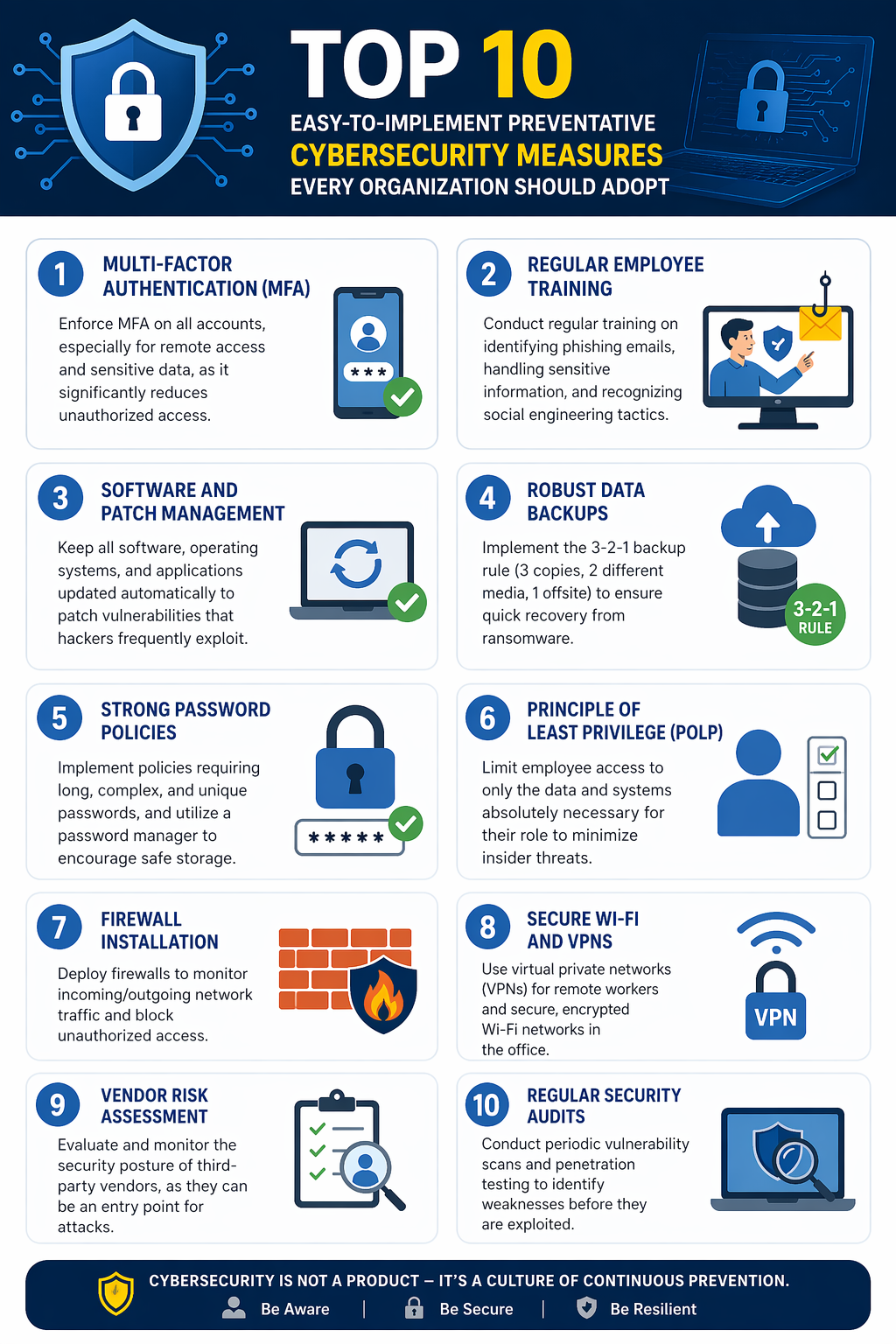
🔐 Top 10 Easy-to-Implement Preventative Cybersecurity Measures Every Organization Should Adopt

Cybersecurity maturity doesn’t always start with expensive tools — it starts with disciplined fundamentals. Here are practical controls that deliver maximum security impact with minimal complexity:

✅ 1. Multi-Factor Authentication (MFA)
Enable MFA across all accounts, especially remote access and privileged users. One of the most effective defenses against account compromise.

✅ 2. Regular Employee Awareness Training
Educate users to identify phishing, social engineering, and data-handling risks. Humans are your strongest defense — or weakest link.

✅ 3. Software & Patch Management
Automate updates for operating systems and applications to eliminate vulnerabilities commonly exploited by attackers.

✅ 4. Robust Data Backup Strategy
Follow the 3-2-1 rule:
• 3 copies of data
• 2 different storage media
• 1 offsite or immutable backup
Critical for ransomware resilience.

✅ 5. Strong Password Policies
Enforce long, unique passwords and promote password managers instead of password reuse.

✅ 6. Principle of Least Privilege (PoLP)
Grant users only the access required for their role. Reduce blast radius during breaches and insider threats.

✅ 7. Firewall Deployment & Monitoring
Use properly configured firewalls to control traffic flow and prevent unauthorized access attempts.

✅ 8. Secure Wi-Fi & VPN Usage
Encrypt corporate wireless networks and require VPN access for remote employees working outside trusted environments.

✅ 9. Vendor & Third-Party Risk Assessment
Your security is only as strong as your weakest partner. Continuously evaluate vendor security posture.

✅ 10. Continuous Security Audits & Testing
Perform vulnerability assessments, configuration reviews, and penetration testing to detect gaps before attackers do.

💡 Cybersecurity is not a product — it’s a culture of continuous prevention.
Strong fundamentals prevent the majority of real-world attacks.

Threat Hunting By Using AI

Here's the complete AI-powered threat hunting lifecycle across 7 phases — click any card to expand the full detail. Here's a summary of what each phase covers:

Phase 1 — Hypothesis formation. AI ingests threat intelligence from MITRE ATT&CK, ISACs, and dark web feeds, then uses NLP to extract TTPs from unstructured reports (PDFs, advisories) and rank hunt hypotheses by risk.

Phase 2 — Data collection. Telemetry is pulled from EDR, network flows, identity systems, and cloud APIs. AI normalises heterogeneous log formats automatically and flags coverage gaps before the hunt starts.

Phase 3 — Anomaly detection & baselines. ML builds per-entity behavioural profiles. UEBA surfaces rare behaviours like beaconing or lateral movement. Graph neural networks trace hidden attack chains across your entire estate.

Phase 4 — Query generation & hunt execution. LLMs convert natural-language hypotheses into optimised SPL/KQL/YARA queries. AI chains low-fidelity signals into full kill-chain narratives before surfacing them to analysts.

Phase 5 — Triage & investigation. AI risk-scores alerts, groups them into unified incidents, writes plain-English attack summaries, and agentic AI autonomously pivots across data sources to complete tier-1 investigation work.

Phase 6 — Containment & response. SOAR playbooks orchestrate response actions (host isolation, account lockdown, firewall rules) across multiple tools in seconds. AI reconstructs the full attacker timeline for post-incident reporting.

Phase 7 — Feedback loop. Confirmed findings are automatically promoted to permanent detection rules. False-positive rates and hunt metrics feed back into the ML models, continuously improving future hypothesis quality and coverage.

The key differentiator of AI-assisted hunting is the feedback loop in Phase 7 — every hunt either operationalises a new rule or improves the model, so the programme compounds in capability over time rather than staying static.

Workplace Policy

🏢 Workplace Policy – Sanji Solutions LLP

At Sanji Solutions LLP, we are committed to fostering a professional, ethical, and growth-oriented work environment that empowers individuals and ensures organizational excellence.

🔹 1. Professional Conduct

All employees are expected to maintain the highest standards of integrity, accountability, and professionalism in all interactions—both internal and external.

🔹 2. Equal Opportunity & Inclusion

We provide a workplace free from discrimination and promote equal opportunities regardless of gender, background, or experience. Diversity and inclusion are core to our culture.

🔹 3. Work Ethics & Productivity

Employees are encouraged to be proactive, meet deadlines, and contribute effectively. Ownership of tasks and continuous improvement are highly valued.

🔹 4. Cybersecurity & Confidentiality

Given our focus on cybersecurity, strict adherence to data protection, confidentiality, and information security policies is mandatory for all team members.

🔹 5. Learning & Development

We promote continuous learning through training, certifications, and hands-on project exposure, especially in emerging technologies like AI and cybersecurity.

🔹 6. Collaboration & Communication

Open communication, teamwork, and knowledge sharing are encouraged to build a strong and innovative work culture.

🔹 7. Flexible & Responsible Work Environment

We support a balanced work culture with flexibility where applicable, while ensuring responsibility and accountability in deliverables.

🔹 8. Compliance & Discipline

All employees must comply with company policies, legal regulations, and client requirements. Any misconduct may lead to disciplinary action.

Director

Priyanka Kamble.

Priyanka Kamble is a visionary cybersecurity leader and the driving force behind Sanji Solutions LLP. With a strong foundation in Digital Forensics, Incident Response, Governance, Risk & Compliance (GRC), and 24/7 Security Operations, she is passionate about transforming how organizations approach cyber resilience.

Priyanka believes that cybersecurity is not merely a technical function — it is a strategic business enabler. Her leadership philosophy centers on proactive defense, continuous innovation, and building a security-first culture within organizations. She is committed to empowering startups and growing enterprises to navigate the digital landscape with confidence and resilience.

Under her guidance, Sanji Solutions has evolved into a trusted cybersecurity partner, focused on anticipating threats before they become crises and aligning security frameworks with long-term business growth. Her mission is clear: to safeguard digital ecosystems, protect organizational reputation, and help businesses thrive securely in an increasingly complex cyber world.

Through collaboration, integrity, and forward-thinking strategy, Priyanka continues to inspire teams and clients alike to view cybersecurity not as a cost, but as a critical investment in sustainable success.

The Rising Threat of Cyber Attacks in 2025

Cyber criminals are no longer just targeting large corporations. Small and medium-sized businesses have become prime targets due to weaker security infrastructures. In this blog, we explore the top cyber threats of 2025 and share practical steps to protect your digital assets.
As businesses continue to digitize operations, cyber attacks are growing more frequent, sophisticated, and damaging. In 2025, organizations of all sizes—from startups to enterprises—are facing increased risks from ransomware, phishing, AI-driven malware, and data breaches.
🚨 Major Cyber Security Threats in 2025
1. Ransomware Attacks on the Rise
Ransomware continues to dominate the cyber threat landscape. Attackers encrypt sensitive business data and demand payment to restore access, often causing operational shutdowns and financial loss.
Impact:
  • Business downtime
  • Data loss
  • Reputation damage
Prevention Tips:
  • Maintain regular data backups
  • Use advanced endpoint protection
  • Implement multi-factor authentication
2. AI-Powered Phishing Attacks
Phishing emails are becoming more convincing with the help of artificial intelligence. Attackers can now create realistic emails, messages, and even voice calls that mimic trusted sources.
Warning Signs:
  • Urgent payment requests
  • Suspicious links or attachments
  • Unexpected login alerts
How to Stay Safe:
  • Train employees regularly
  • Use email filtering solutions
  • Verify requests before acting

Why Modern Businesses Can’t Rely on Traditional Defenses

As organizations embrace digital transformation, the traditional network perimeter has largely disappeared. Employees now access systems from multiple locations, personal devices, and cloud-based platforms, making it impossible to clearly define a “safe” internal network. This shift has created more entry points for attackers to exploit.
At the same time, cyber criminals are using advanced techniques such as stolen credentials, social engineering, and automated attack tools to bypass perimeter defenses. Once inside, attackers can move laterally across systems, gaining access to sensitive data without detection.
🔍 What Is Zero Trust Security?
Zero Trust is a security framework that requires continuous verification of every user, device, and application regardless of location.
Core Principles of Zero Trust:
  • No implicit trust inside or outside the network
  • Continuous authentication and authorization
  • Least-privileged access
⚠️ Why Traditional Security Models Fail
1. Expanding Attack Surfaces
With cloud services, mobile devices, and third-party access, the network perimeter has dissolved.
2. Credential-Based Attacks
Stolen usernames and passwords allow attackers to bypass traditional defenses.
3. Insider Threats
Employees and contractors can accidentally or intentionally expose systems to risks.

How Businesses Can Protect Their Data

Cloud computing has become the backbone of modern business operations. From data storage and application hosting to remote collaboration and scalability, cloud platforms offer unmatched flexibility and efficiency. However, as cloud adoption accelerates, so do cloud-based security threats.
In 2025, attackers are increasingly targeting cloud environments due to misconfigurations, weak access controls, and lack of visibility. This blog explores the most common cloud security risks and outlines best practices businesses can follow to keep their data secure.
⚠️ Common Cloud Security Risks
1. Cloud Misconfigurations
Misconfigured cloud storage, databases, and access permissions remain one of the leading causes of data breaches.
Examples include:
  • Publicly exposed storage buckets
  • Over-privileged user roles
  • Insecure APIs
Impact:
Unauthorized access, data leaks, and compliance violations.
2. Weak Identity and Access Management (IAM)
Poorly managed credentials allow attackers to gain access using stolen or compromised login details.
Risk Factors:
  • Shared accounts
  • Lack of multi-factor authentication
  • Excessive access privileges
🛡️ Why Cloud Security Is a Business Priority
Cloud security is not just an IT issue—it’s a business requirement. A single breach can disrupt operations, damage brand reputation, and result in significant financial loss.
Strong cloud security helps organizations:
  • Maintain data confidentiality
  • Meet regulatory requirements
  • Ensure business continuity

Why Modern Businesses Can’t Rely on Traditional Defenses

As organizations embrace digital transformation, the traditional network perimeter has largely disappeared. Employees now access systems from multiple locations, personal devices, and cloud-based platforms, making it impossible to clearly define a “safe” internal network. This shift has created more entry points for attackers to exploit.
At the same time, cyber criminals are using advanced techniques such as stolen credentials, social engineering, and automated attack tools to bypass perimeter defenses. Once inside, attackers can move laterally across systems, gaining access to sensitive data without detection.
🔍 What Is Zero Trust Security?
Zero Trust is a security framework that requires continuous verification of every user, device, and application regardless of location.
Core Principles of Zero Trust:
  • No implicit trust inside or outside the network
  • Continuous authentication and authorization
  • Least-privileged access
⚠️ Why Traditional Security Models Fail
1. Expanding Attack Surfaces
With cloud services, mobile devices, and third-party access, the network perimeter has dissolved.
2. Credential-Based Attacks
Stolen usernames and passwords allow attackers to bypass traditional defenses.
3. Insider Threats
Employees and contractors can accidentally or intentionally expose systems to risks.

The Rising Threat of Cyber Attacks in 2025

Cyber criminals are no longer just targeting large corporations. Small and medium-sized businesses have become prime targets due to weaker security infrastructures. In this blog, we explore the top cyber threats of 2025 and share practical steps to protect your digital assets.
As businesses continue to digitize operations, cyber attacks are growing more frequent, sophisticated, and damaging. In 2025, organizations of all sizes—from startups to enterprises—are facing increased risks from ransomware, phishing, AI-driven malware, and data breaches.
🚨 Major Cyber Security Threats in 2025
1. Ransomware Attacks on the Rise
Ransomware continues to dominate the cyber threat landscape. Attackers encrypt sensitive business data and demand payment to restore access, often causing operational shutdowns and financial loss.
Impact:
  • Business downtime
  • Data loss
  • Reputation damage
Prevention Tips:
  • Maintain regular data backups
  • Use advanced endpoint protection
  • Implement multi-factor authentication
2. AI-Powered Phishing Attacks
Phishing emails are becoming more convincing with the help of artificial intelligence. Attackers can now create realistic emails, messages, and even voice calls that mimic trusted sources.
Warning Signs:
  • Urgent payment requests
  • Suspicious links or attachments
  • Unexpected login alerts
How to Stay Safe:
  • Train employees regularly
  • Use email filtering solutions
  • Verify requests before acting