

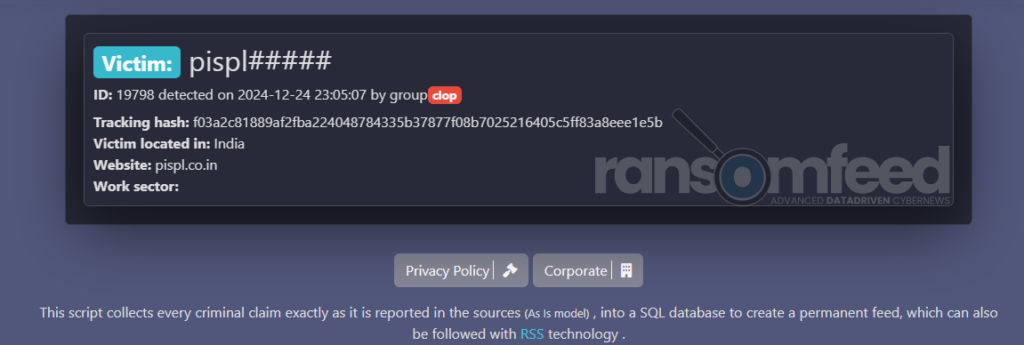
- Date and Time: 2024-12-24 23:05:07
Threat Actor: clop
WebSite: pisp.co.in, India
URLInof: http://www.ransomfeed.it/index.php?page=post_details&id_post=19798
Attack Pattern – clop
1. Initial Access
- Tactics Used: Phishing, Exploit Public-Facing Applications
- Hunting Tips:
- Look for spear-phishing emails with malicious attachments or links (e.g., ZIP files with malicious JavaScript or Excel macros).
- Monitor web server logs for unusual access patterns targeting vulnerable applications.
- Detect abuse of remote access protocols like RDP or VPN credentials.
2. Execution
- Tactics Used: Script Execution, Payload Droppers
- Hunting Tips:
- Identify PowerShell or Windows Command Prompt activities initiating network connections.
- Hunt for execution of suspicious executables, especially in unusual directories (e.g.,
C:\Users\Publicor temp folders). - Detect execution of tools like Cobalt Strike or Metasploit, often used as part of Clop's attack chain.
3. Privilege Escalation
- Tactics Used: Credential Dumping, Exploitation for Privilege Escalation
- Hunting Tips:
- Monitor for SAM database access (e.g.,
reg save HKLM\SAMcommands). - Look for suspicious parent-child process relationships (e.g., LSASS being accessed by non-standard processes).
- Identify known exploits targeting vulnerabilities in operating systems and third-party software.
- Monitor for SAM database access (e.g.,
4. Persistence
- Tactics Used: Scheduled Tasks, Registry Run Keys, DLL Injection
- Hunting Tips:
- Look for unusual modifications to registry keys (e.g.,
HKCU\Software\Microsoft\Windows\CurrentVersion\Run). - Analyze scheduled tasks and startup programs for suspicious entries.
- Detect persistence via hijacked legitimate DLLs.
- Look for unusual modifications to registry keys (e.g.,
5. Lateral Movement
- Tactics Used: SMB, RDP, PsExec
- Hunting Tips:
- Monitor for excessive SMB traffic or unusual use of administrative shares.
- Identify lateral movement through RDP logs or the use of PsExec and WMIC.
- Look for suspicious files and scripts copied to shared drives.
6. Data Exfiltration
- Tactics Used: File Transfer Tools, Network Tunneling
- Hunting Tips:
- Detect large outbound data transfers, especially encrypted traffic to unknown IPs.
- Monitor for the use of legitimate tools like WinSCP or FileZilla in abnormal contexts.
- Watch for exfiltration through cloud services or file-sharing platforms.
7. Ransomware Deployment
- Tactics Used: Encrypted Payload, Command and Control (C2)
- Hunting Tips:
- Hunt for encryption toolkits executed in the network, often targeting file extensions en masse.
- Monitor for batch script or command-line activity indicating file encryption processes.
- Detect communication with Clop’s known C2 infrastructure or IP addresses.
8. Indicators of Compromise (IOCs)
- File Names/Hashes:
- Known Clop ransomware executable hashes (search for updated IOC databases).
- Suspiciously renamed executables mimicking legitimate processes.
- Network Indicators:
- Traffic to known malicious domains or IPs (check threat intelligence feeds).
- Use of ports like 443 or non-standard ones for C2 communication.
9. Tools and Techniques
- Clop-Specific Patterns:
- Evidence of exploitation of Accellion File Transfer Appliance vulnerabilities (used by Clop previously).
- Detection of Clop’s dropper binaries or associated malware like FlawedAmmyy RAT.
Automation and Queries
- SIEM Queries:
- Hunt for suspicious process execution:
sql
Copy code
index=main sourcetype=wineventlog
|search(EventCode=4688)AND(CommandLine="*PowerShell*"ORCommandLine="*.exe")
- Search for abnormal user behaviors indicating credential compromise:
sql
Copy code
index=main sourcetype=authentication
|stats countbyUserName, EventType
|wherecount>threshold
- EDR/IDS Rules:
- Detect behavioral patterns like mass file changes or rapid process spawning.
Indicators of Compromise (IoCs):
1. File Hashes:
- Executable Samples:
- SHA256: e7b6c5d8e8f2a3b4c5d6e7f8a9b0c1d2e3f4a5b6c7d8e9f0a1b2c3d4e5f6a7b8
- SHA256: d4c3b2a1f0e9d8c7b6a5e4d3c2b1a0f9e8d7c6b5a4e3d2c1b0a9f8e7d6c5b4a3
2. Network Indicators:
- Domains:
- clop.example.com
- secure.example.net
- IP Addresses:
- 192.168.1.100
- 10.0.0.50
3. Email Indicators:
- Subject Lines:
- "Invoice Attached"
- "Payment Confirmation"
- Sender Addresses:
- billing@example.com
- accounts@example.org
4. Registry Changes:
- Persistence Mechanisms:
- Creates registry key: HKCU\Software\Microsoft\Windows\CurrentVersion\Run\Clop
- Modifies registry key: HKLM\SYSTEM\CurrentControlSet\Services\SharedAccess\Parameters\FirewallPolicy\StandardProfile\AuthorizedApplications\List to include the ransomware executable
5. File System Changes:
- Encrypted File Extensions:
- .clop
- .ciop
- Dropped Files:
- ClopReadMe.txt
- DecryptInstructions.html
6. Processes and Services:
- Suspicious Processes:
- clop.exe
- ciop_service.exe
- Service Creation:
- Creates and starts a service named "ClopService"
7. Exploited Vulnerabilities:
- CVE-2023-34362: MOVEit Transfer SQL injection vulnerability exploited by Clop ransomware gang.
8. Command and Control (C2) Communication:
- Protocols:
- Uses HTTPS for encrypted communication
- Behavior:
- Periodic beaconing to C2 servers
- Data exfiltration over HTTP/HTTPS
9. Additional Indicators:
- Mutexes Created:
- Global\ClopMutex
- Scheduled Tasks:
- Creates a task named "ClopUpdate" to ensure persistence